
Shawnee County Juvenile Detention Center Overview
The Shawnee County Juvenile Detention Center is operated by the Shawnee County Department of Corrections. It is located at 401 SE 8th Avenue, Topeka, KS 66607, next to the adult detention complex. The official main phone number is 785-251-7700. The office fax listed in the research file is 785-251-4963, and the court transport fax is 785-251-4964.
The facility is a secure juvenile detention center, not an adult jail. Its population is described in the facility map as juvenile residents pending court action, serving juvenile detention, or waiting for transfer. Juvenile residents are handled under a different access framework than adults on the Shawnee County DOC public inmate search. The page should not promise adult-style public roster access, adult mugshots, or open profile fields for youth held at the JDC.
The county's organization history explains that the Juvenile Detention Center was added with adult detention additions in 1998, allowing shared support operations such as food service, accounting, records, laundry, maintenance, and other facility functions. That shared campus does not make juvenile records public in the same way as current adult jail records.
The official Shawnee County DOC organization page lists the Juvenile Detention Center with county detention facilities and capacity information.
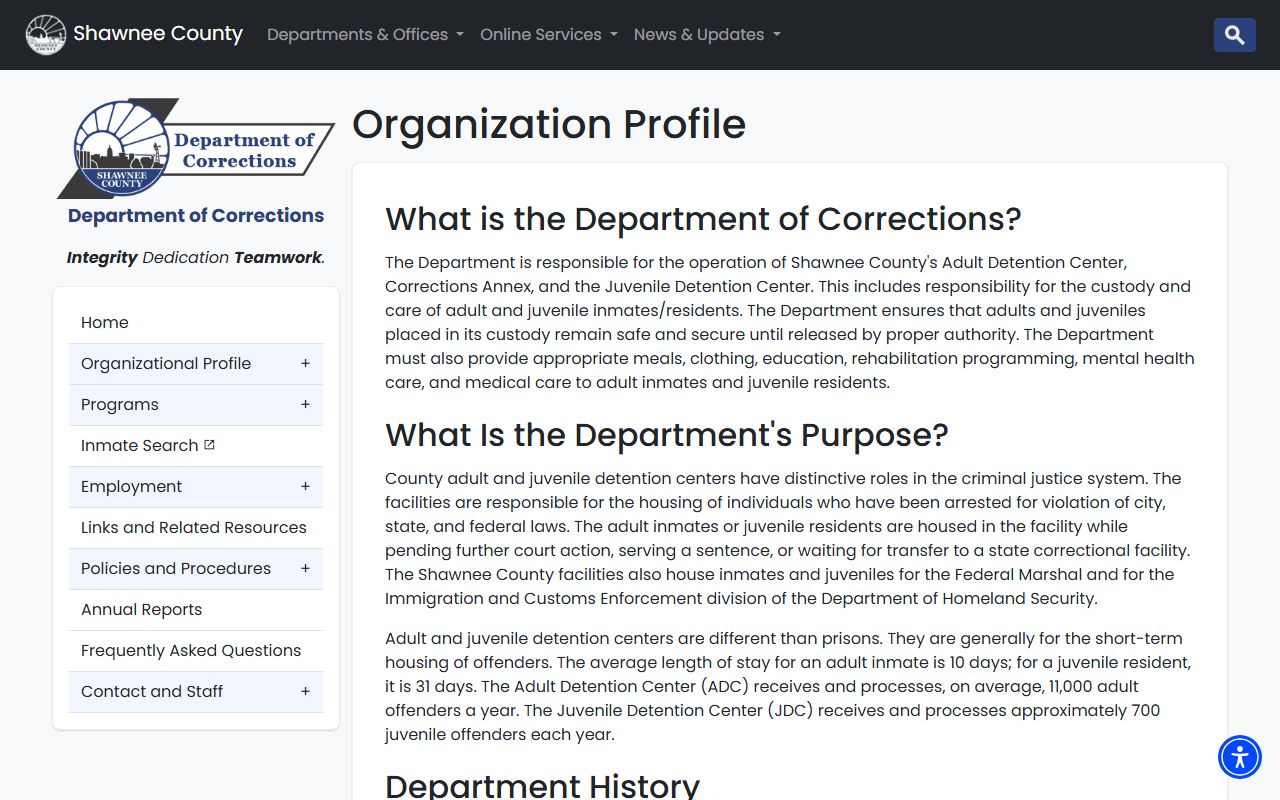
That source supports the facility's placement in the Shawnee County DOC system and the capacity figure used below.
Juvenile Detention Center Capacity
Official county pages list the Juvenile Detention Center with 70 beds. The department profile and organization profile conflict on juvenile average length of stay. One source says 14 days, while the organization profile says 31 days. The research file preserves both figures as an official-source discrepancy rather than choosing one without context. No official current daily population count for the JDC was located in accessible source material during the research pass.
| Measure | Published Detail | Source Limit |
|---|---|---|
| JDC capacity | 70 beds | Shawnee County DOC organization and department profile pages |
| Juvenile average stay | 14 days or 31 days | Official pages conflict, so both figures are preserved |
| Current population | Not located in accessible official source | No public JDC daily population total extracted |
| Roster access | No adult-style public roster promised | Juvenile records are often confidential |
Check Juvenile Custody Status
The adult Shawnee County DOC inmate search is built around adult jail custody records. It should not be used as a promise that juvenile residents are publicly listed with adult booking photos, charge fields, and bond information. For a youth believed to be held at the Shawnee County Juvenile Detention Center, the safer access path is a direct facility or court contact by a parent, legal guardian, attorney, or other person with authority to receive information.
- Call the Juvenile Detention Center main phone at 785-251-7700 for routing and confirmation steps.
- Be prepared to identify the youth and explain your relationship or legal role.
- Contact the juvenile court or assigned attorney for hearing, release, or court-order questions.
- Do not rely on the adult jail roster for juvenile custody status or juvenile records.
Adult systems still matter when a reader is looking for an adult relative or a person who may have been transferred out of juvenile jurisdiction. Adults in county custody use the county DOC roster, sentenced state prisoners use KASPER, federal prisoners use the BOP locator, and immigration detainees use ICE ODLS. Juvenile custody is different because privacy and court rules can limit what appears online.
Juvenile access note: A missing public roster entry does not prove a youth is not held or not involved in a case.
Juvenile Detention Center Contact
The JDC has a separate phone number from the adult facility. Use that line for juvenile detention routing, visitor questions, and facility-specific procedures. Because juvenile records can be restricted, staff may require proof of relationship or legal authority before discussing details. The adult jail information line should not be the only source for JDC questions.
Shawnee County Juvenile Detention Center
401 SE 8th Avenue
Topeka, KS 66607
785-251-7700
Office fax: 785-251-4963; court transport fax: 785-251-4964
Juvenile Detention Center Visits
Shawnee County publishes a specific juvenile visitation schedule and tighter visitor limits. Each juvenile resident is permitted one visit per visitation day. No more than two adults, or one adult and one child, may visit at one time. Approved visitors include parents, legal guardians, grandparents, and siblings. A sibling must be accompanied by a parent, legal guardian, or grandparent. Visits last 25 minutes, and visitors report to the JDC front lobby for check-in.
The Shawnee County DOC visitation page is the matched official source for the juvenile schedule, visitor categories, clothing rules, ID rules, and lobby procedures.
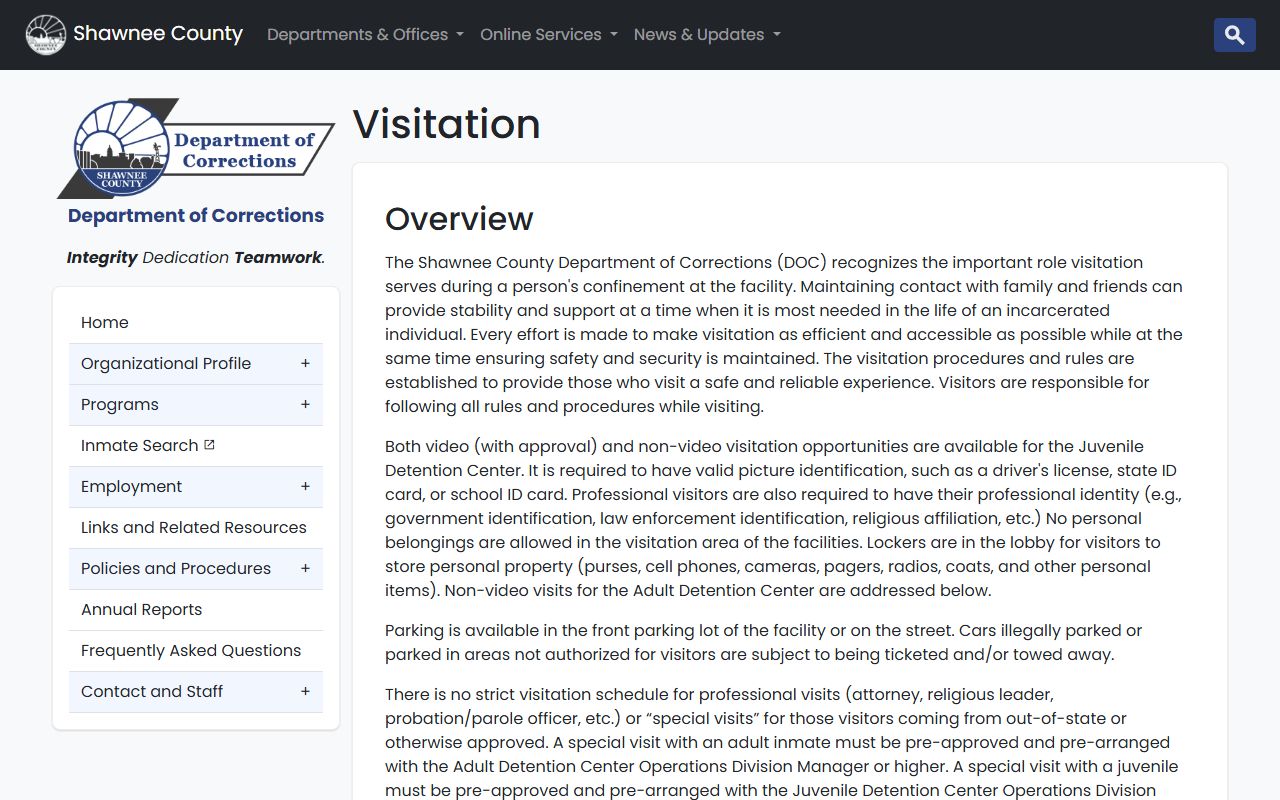
The juvenile schedule is narrower than adult visitation and should be checked before each trip because facility security needs can change.
| Day | Hours | Type |
|---|---|---|
| Tuesday | 6:30 p.m., 7:00 p.m., 7:30 p.m. | Juvenile family visit |
| Friday | 6:30 p.m., 7:00 p.m., 7:30 p.m. | Juvenile family visit |
| Saturday | 10:00 a.m., 10:30 a.m., 11:00 a.m. | Juvenile family visit |
| Sunday | 10:00 a.m., 10:30 a.m., 11:00 a.m. | Juvenile family visit |
Juvenile Mail and Funds
The research file groups inmate and resident correspondence under Shawnee County DOC rules. Incoming mail must come through USPS. Personal mail rules require clear name and identifying information and a return name and address. Legal mail is treated differently and is inspected in the person's presence. Because the mail source uses adult jail examples and the JDC has a distinct resident population, confirm the current juvenile addressing format with JDC staff before mailing personal items, money instruments, or publications.
Resident accounts may be used for fees or commissary where allowed. The inmate-funds page says inmates and residents may maintain an account, and it lists acceptable mailed deposit instruments such as bank money orders, attorney trust account checks, cashier's checks, government checks, tribal checks, and checks from other correctional facilities. Unauthorized checks can be returned at resident expense. Cash by mail is not the safe path.
| Service | Juvenile Detention Detail |
|---|---|
| Personal mail | USPS mail rules apply, but confirm the JDC format before sending |
| Legal mail | Handled separately and inspected in the resident's presence |
| Resident funds | Use only acceptable instruments or official county payment paths |
| Publications | Must come from approved publisher or retailer channels under DOC rules |
Juvenile Intake Process
Juvenile detention intake is not the same as adult street-arrest booking. The research identifies JDC residents as youth pending court action, serving juvenile detention, or awaiting transfer. The facility is secure, but the custody path is tied to juvenile court rules and privacy limits. The county medical and mental-health page says all inmates and residents receive an initial health screening at booking, and mental-health professionals screen incoming inmates and residents for acute events, medication needs, counseling, and release transition planning.
Families should avoid adult bond assumptions for juvenile cases. An adult jail profile may show cash bond, professional surety, own recognizance, or no-bond status. Juvenile release, placement, detention review, and court directives can follow a different process. The juvenile court, counsel, and facility staff are the proper sources for those questions.
About JDC Programs
The Shawnee County DOC program page documents juvenile programs that are distinct from the adult jail list. Juvenile programs include Man's Best Friend, gardening, Positive Connections, weekly arts and crafts, Gear Up college readiness, One Heart mentoring, Forward Thinking Journal, church services, weekly life and social skills, USD 501 classroom education Monday through Friday, daily gym exercise, monthly barber services, commissary, and "Save Your Self" facilitated by Women Empowerment Inc.
Medical and mental-health care are also part of the facility framework. The county contracts with Armor Correctional Health Care, and the research says medical services are provided 24 hours a day. Mental-health staff screen incoming residents, address acute events, psychotropic medication, counseling needs, and transition to community services on release. Those services are facility functions, not public roster fields.
Note: Confirm juvenile custody information, visit approval, and mail rules directly with JDC staff or the court.